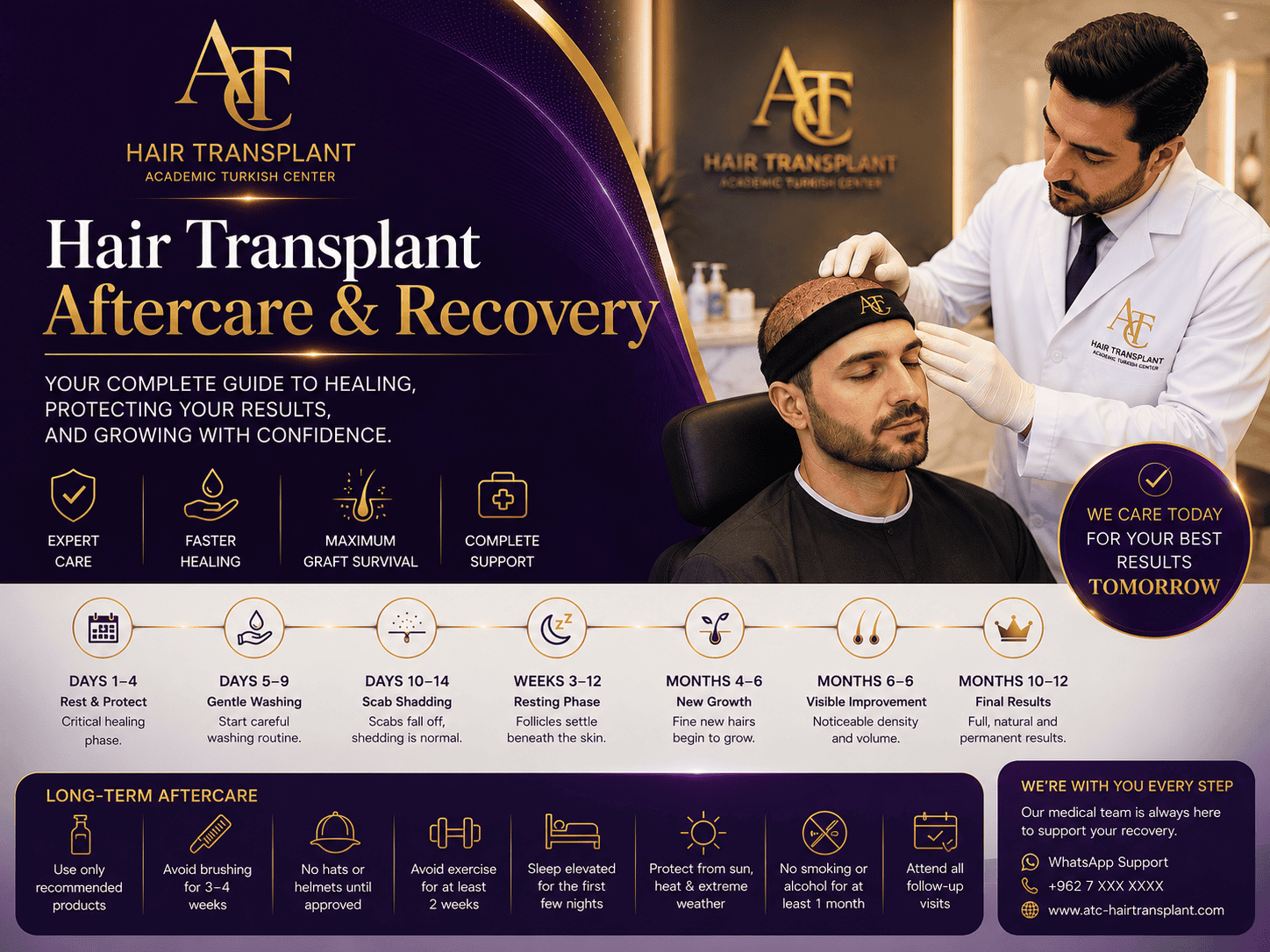
Your hair transplant journey doesn't end when the procedure is complete. Proper aftercare plays a vital role in protecting your newly transplanted grafts and achieving the best possible results. At ATC Hair Transplant, our medical team will guide you through every stage of your recovery, providing personalized instructions and continuous support throughout the healing process.
Following the recommended aftercare routine will help reduce swelling, promote faster healing, and maximize the survival rate of your transplanted hair follicles.
Before Your Hair Transplant
A successful hair transplant begins with proper preparation. Before the day of your procedure, our specialists will ensure you are fully informed and ready both physically and mentally.
Before Your Procedure
- Discuss every aspect of the procedure with your medical consultant.
- Stop smoking at least 7 days before surgery.
- Avoid aspirin or blood-thinning medications as instructed by your doctor.
- Avoid alcohol, caffeine, and green tea for 3 days before surgery.
- Plan to rest for at least 3 days after the procedure.
- Eat a healthy breakfast on the day of surgery.
- Wear comfortable clothing with buttons or a zipper to avoid pulling clothes over your head.
- Arrive at the clinic on time.
The procedure is performed under local anesthesia, allowing you to remain awake and comfortable throughout the treatment.
Day of the Procedure
Upon arrival at the clinic, you will be welcomed by our medical team and prepared for your treatment. Your procedure includes:
- Final consultation with your specialist.
- Pre-operative scalp examination.
- Professional medical photography for documentation.
- Personalized hairline design based on your facial features.
- Administration of local anesthesia.
- Hair follicle extraction using Sapphire FUE technology.
- Precise implantation of the grafts.
- Detailed post-operative instructions.
- Your complete aftercare kit before leaving the clinic.
Our team will remain with you throughout the entire procedure to ensure your comfort and answer any questions you may have.
Days 1–4: Critical Healing Phase
The first four days are the most important period for protecting your newly transplanted grafts.
During This Stage
- Use the saline spray regularly to keep the scalp hydrated.
- Sleep with your head elevated at a 45° angle.
- Do not touch, scratch, or rub the transplanted area.
- Avoid physical activity.
- Get plenty of rest.
Normal Symptoms
It is completely normal to experience:
- Mild redness
- Slight swelling
- Minor itching
- Tightness of the scalp
These are natural signs that your body is healing.
Days 5–9: Early Recovery
During this period, small scabs begin forming around each transplanted follicle.
Care Instructions
- Begin washing your hair following your specialist's instructions.
- Dilute the shampoo with lukewarm water before applying.
- Gently pour the water over your scalp instead of using direct water pressure.
- Pat your scalp dry using a soft towel.
- Never rub the transplanted area.
Days 10–14: Scab Removal Phase
Around the second week, the scabs gradually begin to fall away.
Important Notes
- Some transplanted hairs may shed.
- This is called Shock Loss and is completely normal.
- The hair follicles remain healthy beneath the skin.
- Continue using a gentle shampoo recommended by your medical team.
Weeks 3–12: Resting Phase
Many patients worry during this period because little visible progress occurs. In reality, your transplanted follicles are becoming firmly established beneath the skin.
During this stage:
- Hair growth temporarily pauses.
- Mild dryness or itching may continue.
- The follicles are preparing for a new growth cycle.
Patience is essential.
Months 4–6: New Hair Begins to Grow
This is when patients begin noticing exciting changes. You may observe:
- Fine new hairs emerging.
- Gradual improvement in density.
- Stronger hair texture each month.
- A more natural appearance.
Hair growth varies from patient to patient, but visible improvement becomes increasingly noticeable.
Months 6–9: Significant Improvement
Hair continues to mature and fill in the treated areas. During this stage, patients usually notice:
- Fuller hair coverage.
- Better overall density.
- Easier hair styling.
- Increased confidence.
Months 10–12: Final Results
Most patients achieve their final results between 10 and 12 months after surgery. By this stage:
- Hair reaches its maximum density.
- Texture becomes more natural.
- The transplanted hair can be cut, styled, and treated like your natural hair.
- Your specialist may recommend supportive treatments if additional density is desired.
Hair Washing Guide
Proper washing is one of the most important parts of your recovery.
Step 1 – Apply the Lotion
Apply the recommended foam or lotion to the transplanted area and leave it for approximately 30 minutes to soften the scabs.
Step 2 – Rinse with Lukewarm Water
Gently rinse your scalp using lukewarm water without applying direct pressure.
Step 3 – Apply Medical Shampoo
Place a small amount of the recommended shampoo in your hands and gently massage the scalp using soft circular motions.
Step 4 – Final Rinse
Carefully rinse away all shampoo residue using lukewarm water.
Step 5 – Dry Carefully
Pat your scalp dry using a soft towel or use a cool-air hair dryer from a safe distance.
Long-Term Aftercare
To protect your results, follow these recommendations:
- Only use products recommended by your medical team.
- Avoid brushing the transplanted area for 3–4 weeks.
- Do not wear hats or helmets until approved by your doctor.
- Avoid strenuous exercise for at least 2 weeks.
- Sleep with your head elevated during the first few nights.
- Protect your scalp from excessive heat and direct sunlight.
- Avoid smoking and alcohol for at least one month.
- Attend all scheduled follow-up appointments.
Recovery Timeline
| Time | What to Expect |
|---|---|
| Day 1 | Mild swelling and redness |
| Days 2–4 | Healing begins |
| Days 5–9 | Scab formation |
| Days 10–14 | Scabs fall off |
| Weeks 3–12 | Resting phase |
| Months 4–6 | New hair growth |
| Months 6–9 | Increased density |
| Months 10–12 | Final natural results |
Final Thoughts
Every patient's recovery journey is unique, but following your specialist's instructions carefully is the key to achieving the best possible outcome. At ATC Hair Transplant, we support you throughout every stage of recovery — from your first consultation to your final results — ensuring a safe, comfortable, and successful hair restoration experience.